Pages

Showing posts with label by. Show all posts

Saturday, January 14, 2017

Make Your Windows 7 Genuine by Command Prompt Computer Tips

Make Your Windows 7 Genuine by Command Prompt: Computer Tips


How to make your windows 7 genuine by command prompt. So, follow my image instruction ...Lets Go............

# 1st step: Go to start menu and type cmd and right click on the cmd icon

Windows 7 Genuine1


# Step 2: then click in "Run as administrator" then press ok
 Windows 7 Genuine2


# Step 3: Type this command " SLMGR -REARM " then press ok

 Windows 7 Genuine3

# Step 4:  Wait a seconds
 Windows 7 Genuine4


# Step 5: then successfully complete this task and restart your computer and get your windows genuine,
 Windows 7 Genuine5


Read More..

Friday, January 13, 2017

New ways to add Reminders in Inbox by Gmail


Last week, Inbox by Gmail opened up and improved many of your favorite features, including two new ways to add Reminders.

First up, when someone emails you a to-do, Inbox can now suggest adding a Reminder so you don’t forget. Heres how it looks if your spouse emails you and asks you to buy milk on the way home:
To help you add Reminders, the Google Research team used natural language understanding technology to teach Inbox to recognize to-dos in email.
And much like Gmail and Inbox get better when you report spam, your feedback helps improve these suggested Reminders. You can accept or reject them with a single click:
The other new way to add Reminders in Inbox is to create Reminders in Google Keep--they will appear in Inbox with a link back to the full note in Google Keep.
Hopefully, this little extra help gets you back to what matters more quickly and easily. Try the new features out, and as always, let us know what you think using the feedback link in the app.
Read More..

Sunday, October 9, 2016

Groundbreaking simulations by Google Exacycle Visiting Faculty


In April 2011, we announced the Google Exacycle for Visiting Faculty, a new academic research awards program donating one billion core-hours of computational capacity to researchers. The Exacycle project enables massive parallelism for doing science in the cloud, and inspired multiple proposals aiming to take advantage of cloud scale. Today, we would like to share some exciting results from a project built on Google’s infrastructure.

Google Research Scientist Kai Kohlhoff, in collaboration with Stanford University and Google engineers, investigated how an important signalling protein in the membrane of human cells can switch off and on by changing its three-dimensional structure following a sequence of local conformational changes. This research can help to better understand the effects of certain chemical compounds on the human body and assist future development of more potent drug molecules with fewer side effects.

The protein, known as the beta-2 adrenergic receptor, is a G protein-coupled receptor (GPCR), a primary drug target that plays a role in several debilitating health conditions. These include asthma, type-2 diabetes, obesity, and hypertension. The receptor and its close GPCR relatives bind to many familiar molecules, such as epinephrine, beta-blockers, and caffeine. Understanding their structure, function, and the underlying dynamics during binding and activation increases our chances to decode the causes and mechanisms of diseases.

To gain insights into the receptor’s dynamics, Kai performed detailed molecular simulations using hundreds of millions of core hours on Google’s infrastructure, generating hundreds of terabytes of valuable molecular dynamics data. The Exacycle program enabled the realization of simulations with longer sampling and higher accuracy than previous experiments, exposing the complex processes taking place on the nanoscale during activation of this biological switch.

The paper summarizing the results of Kai’s and his collaborators’ work is featured on the January cover of Nature Chemistry, with artwork by Google R&D UX Creative Lead Thor Lewis, to be published on December 17, 2013. The online version of his paper was published on their website today.

We are extremely pleased with the results of this program. We look forward to seeing this research continue to develop.
Read More..

Monday, July 11, 2016

Berkeley Earth Maps Powered by Google Maps Engine now available in the Google Maps Gallery


Google Maps is a familiar and versatile tool for exploring the world, but adding new data on top of Google Maps has traditionally required expending effort for both data management and website scripting. Google recently expanded Google Maps Engine and debuted an updated Google Maps Gallery. These tools aim to make it easier for users and organizations to integrate their geographic data with Google Maps and share it with the world. At Berkeley Earth we had an early opportunity to work with these new tools.

The use of Google Maps Engine eliminates the need for users to run their own map-serving Web servers. Maps Engine also handles mundane mapping tasks, such as automatically converting georeferenced image files into beautiful map layers that can be viewed in Google Maps, no programming required.


Annual average land-surface temperature during the period 1951-1980 as estimated by Berkeley Earth.

Similarly, one can take tables of location data and map them onto a Google Map using geographic markers and popup message boxes that make it easy to explore georeferenced information.


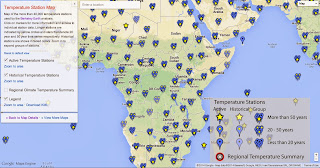
Map of the more than 40,000 temperature stations used by the Berkeley Earth analysis. On the left is part of the original table of data. On the right is its representation in Google Maps Engine.

When mapping locations, the new Maps Engine tools allows users to upload their own geographic markers or chose from Google’s many selections; the geographic marker icons used in the temperature station map above were uploaded by us. Alternatively, we could have used one of the stock icons provided by Maps Engine. In addition, users can customize the content and appearance of the popup message boxes by using HTML. If the georeferenced data can be linked the web addresses of already existing online content, one can also incorporate images or outgoing links within the message boxes, helping the user find more information about the content presented in the map.

The ease of putting image layers into the new Maps Engine has allowed Berkeley Earth to create and share many scalable maps of climate and weather information that are fun to explore. Incorporating these maps in our website and posting them on the Google Maps Gallery provides the public with a new tool to help locate local weather stations, learn about local climate, and download various kinds of weather and climate data.

Now, anyone can easily learn about both the weather in their city and the climate of the entire globe from a single, simple interface. Google Maps Engine and the new Maps Gallery has allowed us to bring the story of climate to a broad audience in a way that can be easily understood.
Read More..

Monday, July 4, 2016

Embeeded Systems Notes TY BSc IT by MICHAEL BARR OREILLY


Programming Embedded Systems in C and C++
This book is recommended by most of the teachers in most of the colleges. It contains almost all necessary programs for practice.

This book introduces embedded systems to C and C++ programmers. Topics include testing memory devices, writing and erasing Flash memory, verifying nonvolatile memory contents, controlling on-chip peripherals, device driver design and implementation, optimizing embedded code for size and speed, and making the most of C++ without a performance penalty.

  • Click to download
Reblog this post [with Zemanta]
Read More..

Saturday, April 9, 2016

Learning Statistics with Privacy aided by the Flip of a Coin


(Cross-posted on the Chromium Blog and the Google Online Security Blog)

At Google, we are constantly trying to improve the techniques we use to protect our users security and privacy. One such project, RAPPOR (Randomized Aggregatable Privacy-Preserving Ordinal Response), provides a new state-of-the-art, privacy-preserving way to learn software statistics that we can use to better safeguard our users’ security, find bugs, and improve the overall user experience.

Building on the concept of randomized response, RAPPOR enables learning statistics about the behavior of users’ software while guaranteeing client privacy. The guarantees of differential privacy, which are widely accepted as being the strongest form of privacy, have almost never been used in practice despite intense research in academia. RAPPOR introduces a practical method to achieve those guarantees.

To understand RAPPOR, consider the following example. Let’s say you wanted to count how many of your online friends were dogs, while respecting the maxim that, on the Internet, nobody should know you’re a dog. To do this, you could ask each friend to answer the question “Are you a dog?” in the following way. Each friend should flip a coin in secret, and answer the question truthfully if the coin came up heads; but, if the coin came up tails, that friend should always say “Yes” regardless. Then you could get a good estimate of the true count from the greater-than-half fraction of your friends that answered “Yes”. However, you still wouldn’t know which of your friends was a dog: each answer “Yes” would most likely be due to that friend’s coin flip coming up tails.

RAPPOR builds on the above concept, allowing software to send reports that are effectively indistinguishable from the results of random coin flips and are free of any unique identifiers. However, by aggregating the reports we can learn the common statistics that are shared by many users. We’re currently testing the use of RAPPOR in Chrome, to learn statistics about how unwanted software is hijacking users’ settings.

We believe that RAPPOR has the potential to be applied for a number of different purposes, so were making it freely available for all to use. Well continue development of RAPPOR as a standalone open-source project so that anybody can inspect and test its reporting and analysis mechanisms, and help develop the technology. We’ve written up the technical details of RAPPOR in a report that will be published next week at the ACM Conference on Computer and Communications Security.

We’re encouraged by the feedback we’ve received so far from academics and other stakeholders, and we’re looking forward to additional comments from the community. We hope that everybody interested in preserving user privacy will review the technology and share their feedback at rappor-discuss@googlegroups.com
Read More..

Wednesday, July 16, 2014

Breakthrough by IBM May Bring Us Exascale Supercomputers

If you are one of the people out there that doesnt think that a supercomputer seems good enough, then you probably work at IBM. Researchers at IBM have just made a breakthrough in using light pulses to help accelerate the transfer of data between chips. If this works out like the people at IBM think it will, then it could quite possibly increase supercomputer performance by more than a thousand times.

This technology, dubbed CMOS Integrated Silicon Nanophotonics (I feel smarter already), integrates optical modules as well as electrical modules on a single piece of silicon. This allows electrical signals created at the transistor level to be transformed into light pulses, seemingly allowing chips to communicate faster according to IBM silicon photonics research scientist Will Green.

IBM believes that this new technology will lead to massive advances in supercomputer power. The fastest supercomputers we have around today max out at nearly 2 petaflops which, for us lay people, registers into two thousand trillion calculations per second. The photonics technology could increase this number to a staggering trillion million calculations per second. Yeah, a MILLION TRILLION calculations per second, otherwise known as an exaflop. This would help IBM achieve their goal of building an exascale computer by the year 2020.

According to Green, "In an exascale system, interconnects have to be able to push exabytes per second across the network. This is an interesting milestone for system builders who are looking at building exascale systems in 10 years."

The possibility of integrating multiple photonics modules onto a single substrate or onto a motherboard is here, according to Green. Newer supercomputers already use optical technology for chips in order to communicate. However, this usually occurs at the rack level and mostly over a single wavelength. This breakthrough will allow optical communication simultaneously at multiple wavelengths.

The good thing about this technology is that it can be manufactured on a standard chip production line. Another benefit is that it also needs no special tools, making it extremely cost-effective. The current demonstration used a 130-nanometer CMOS manufacturing node. However, IBM plans on pursuing integration into "deeply scaled sub-100 nanometer CMOS processes," according to Green.

The technology aims to replace copper wires. As you know, copper wires are widely used today for data transfer between chips. Optics can get a speed increase for distances as short as a few centimeters to as long as a few miles and even consumes less power. Eventually, IBM hopes to use optics for on-chip communication between transistors as well. According to Green, "There is a vision for the chip level, but that is not what we are claiming today."
A Laptop Rental is perfect if you are hosting a classroom training session or if you are just headed to another convention. Take the hassle out of your business trip. Rentacomputer.com has been offering quality laptop rentals for over 20 years to more than 1000 cities worldwide.
Read More..

Wednesday, May 21, 2014

Step By Step guide to Read XML file in Java Using SAX Parser Example

Reading XML file in java using SAX Parser is little different than reading xml file in Java with DOM parser which we had discussed in last article of this series. This tutorial is can be useful for those who are new to the java world and got the requirement for read an xml file in java in their project or assignment, key feature of java is it provides built in class and object to handle everything which makes our task very easy. Basically this process of handling XML file is known as parsing means break down the whole string into small pieces using the special tokens.
Parsing can be done using two ways:
Read more »
Read More..

Monday, May 19, 2014

Autodesk Labs Role Guest Post by Scott Sheppard

Autodesk Labs Program Manager, Scott Sheppard, is our guest Blogger today.  he talks to us about Autodesk Labs role at Autodesk, as well as some of its history.

Autodesk Labs got its start with Shaan Hurley. Shaan was working on our Beta program back then and wished he could involve users earlier. We love our beta programs. We manage them on http://beta.autodesk.com Participants sign up, test the software, and provide feedback under a Non-Disclosure Agreement. Though from the customer perspective this is early in the release process, it’s actually closer to the end of the process in software development terms. So although beta testers may have great ideas like “Why don’t you redo this whole thing this way?”, there really isn’t time to start over from scratch. The primary emphasis of many beta programs is to learn if the software works or not. Our QA teams have already put the release through its paces, but there’s no substitute for having customers try it with their own data to ensure that something is ready to ship.

Autodesk Labs was born to involve the customer earlier in the process – where there is actually enough time to act on a suggestion like “Why don’t you redo this whole thing this way?” We are careful to call what we put on Labs “technology previews” instead of alphas or betas, because we want to ensure that there are no misconceptions about something becoming a product or making it into an existing product. We make technology previews available on Labs so people can help shape their future. Some die a quick death. For example, users were not so happy with our attempt at visual search where users could locate parts by drawing crude shapes. Others take a while to perfect but go on to greatness. Autodesk Inventor LT was on Labs for 2 years before becoming a product. Autodesk Impression was one of the first technologies to graduate from Labs. It is now a feature of AutoCAD.

As an organization within Autodesk, we have 2 roles.

1.  Our Labs team looks at industry trends and creates prototypes that attempt to turn the possible into the practical. Way back before the iPhone, we instrumented a copy of Autodesk Design Review to run on our Perceptive Pixel Multi-touch Wall. We learned a great deal about the gestures that would be appropriate for working with CAD data without a mouse or keyboard. Even further back than that, we created Project Freewheel to see if it were really possible to view 3D (not 2D, 2D was easy) CAD data on the web using just a browser. We learned a great deal about high-end graphics cards that were not common in cloud computing servers like those from Amazon EC2.

2.  Our second role is to be a service organization to the rest of Autodesk. We get technologies from various departments and help make them available via the Autodesk Labs site. Most of the items you find on Labs came from somewhere else within the company. The Labs team has worked on Project Freewheel, Project Draw, Project Showroom, ShareNow, and Project Twitch, but everything else is from another part of the company. We are happy to play this role as we encourage other parts of the company to develop their technologies by involving the customer early in the process. We also help with the mechanics of it by creating web pages, email aliases, discussion forums, etc. We also use social media (e.g. blogs, Facebook, Twitter) to get the word out. We produce monthly reports, that I loving call TPS reports in reference to Office Space, that summarize feedback and include site visitor and download statistics.

Thanks Scott for being our guest blogger today and for all of the great work that Autodesk Labs puts out.
Read More..